
Top 10 Grounds for Divorce in Nevada: Real Examples
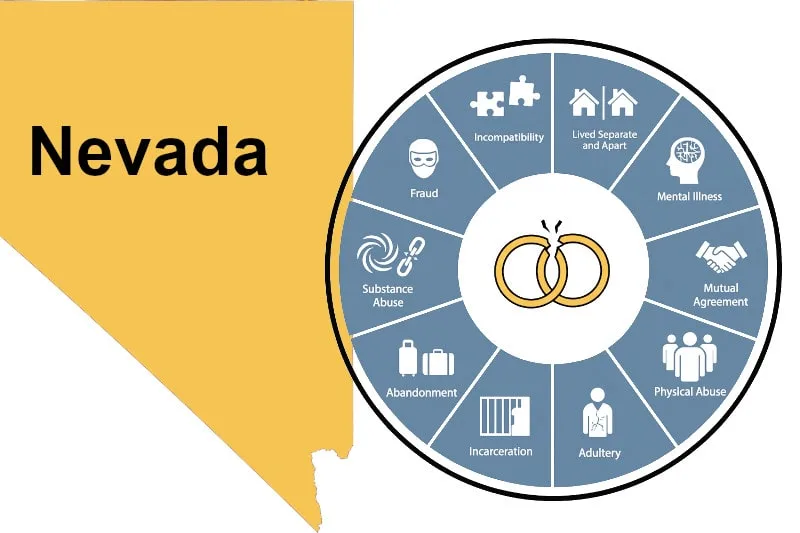
Thinking about divorce can be overwhelming. You might have questions about what legally qualifies as a reason to end a marriage in Nevada, or whether your situation “counts.” Understanding the grounds for divorce can help you reflect on your own circumstances and prepare for what’s ahead.
Nevada is a no-fault divorce state, which means that most divorces don’t require one spouse to prove wrongdoing. Still, there are causes recognized under Nevada law, including both no-fault and fault-based reasons.
Let’s break down the top 10 grounds for divorce with real-world examples, focusing on the most common reasons our clients tell us their marriage has ended, where neither spouse has to prove any misconduct.
The Three Statutory Grounds
Incompatibility (No-Fault)
This is the most common reason for divorce in Nevada. It simply means that spouses are no longer able to live together happily.
Example: You and your spouse constantly argue about finances, parenting, or lifestyle choices, and attempts to reconcile haven’t worked. It’s not about assigning blame — it’s about acknowledging the relationship isn’t working.
Lived Separate and Apart (No-Fault)
This is the state’s other statutory no-fault ground, requiring only a physical separation for a continuous period.
Example: Your spouse has physically lived in a separate residence from you for at least one year without resuming marital relations, proving the marriage is over.
Mental Illness (Statutory Fault Ground)
In rare cases, a spouse’s severe mental condition can be a basis for divorce under the official statutory ground of Insanity.
Example: Your spouse has been declared legally insane for at least two years prior to filing. Note that this is rarely used today, as the no-fault option is simpler, but it remains on the books.
Reasons That Prove Incompatibility or Affect Property/Custody
These following grounds are not filed as stand-alone causes, but they are the most common reasons people file and are often used as powerful evidence for divorce or for issues like custody and asset division.
Mutual Agreement (Filing on Incompatibility)
Nevada allows divorces by mutual consent, where both parties agree to the dissolution. The legal ground cited in the paperwork, however, is almost always Incompatibility.
Example: You and your spouse both agree that divorce is the best path, and you want to simplify the process without airing disputes in court (an Uncontested Divorce).
Adultery (Affects Property Division)
Nevada is a no-fault divorce state, and adultery is not a legal ground for divorce. However, if a spouse used community property to fund the affair, this can result in an unequal division of the marital property to compensate the non-offending spouse.
Example: Your spouse spent $15,000 from joint savings on an affair. In Nevada, this “wasteful dissipation” can reduce their share, protecting your portion of the assets.
Physical Abuse or Domestic Violence (Affects Custody)
Safety is a legitimate reason to end a marriage, and courts take abuse seriously. While it instantly proves Incompatibility, the primary legal factor here is its impact on child custody and the need for protective orders.
Example: If you experience repeated threats, violence, or harassment from your spouse, it may justify divorce and directly factor into the court’s final custody determination.
Abandonment / Desertion (Proving Incompatibility)
When one spouse leaves the marital home without justification, it is strong evidence of the marriage’s breakdown. If the abandonment is for less than one year, it is used to prove the overarching ground of Incompatibility.
Example: Your spouse moves out, stops contributing financially, and cuts off communication for six months. This behavior is used as proof that the marriage is incompatible.
Substance Abuse (Proving Incompatibility & Waste)
Chronic alcohol or drug use that destroys the marriage proves Incompatibility. It can also affect financial division (if money was wasted on the addiction) and is a serious factor in child custody determinations.
Example: One spouse’s ongoing addiction leads to financial problems, missed responsibilities, or unsafe situations at home, prompting the divorce and leading to restricted custody.
Incarceration (Proving Incompatibility)
If a spouse is convicted of a crime and incarcerated, it provides definitive proof that the marriage is broken and meets the ground of Incompatibility.
Example: Your spouse is serving a long prison sentence, making it impossible to maintain the marital relationship.
Other Legal Issues (Annulment/Fraud)
This category covers less common scenarios that may not result in a standard divorce but an annulment (as if the marriage never happened) or a judgment based on fraud.
Example: A spouse discovers that the other was already married at the time of your wedding (Bigamy) — Nevada law provides grounds to challenge or dissolve the marriage via annulment.
Unusual or “Absurd” Reasons
Divorce can happen for all sorts of reasons — some might seem unusual or even absurd to an outside observer. But what feels trivial to one person can be a real dealbreaker for another.
For example, we once had a client who sought a divorce because her husband’s chronic snoring made it impossible for her to sleep or maintain her health. While it might sound minor to some, it was serious for her and impacted her daily life.
Nevada law recognizes that every marriage is unique, and what matters most is whether the relationship is no longer working for those involved. Even seemingly small issues can justify a divorce if they create ongoing strain or unhappiness, proving Incompability.
Reflecting on Your Situation
Thinking about divorce is rarely easy. Reading through these grounds can help you identify whether your situation fits one or more categories.
You may also realize that, in Nevada, no-fault divorces make it simpler to move forward even if there’s no clear misconduct.
If you’re considering divorce in Nevada and want guidance on your options, property division, or custody considerations, contact Smith Legal Group at 702-410-5001 to schedule a free consultation at our Henderson office.
Understanding your situation early can help you make informed decisions and protect your future.
Disclaimer: The information in this blog post is provided for general informational purposes only, and may not reflect the current law in your jurisdiction. No information contained in this blog post should be construed as legal advice. No reader of this post should act or refrain from acting on the basis of any information included in this blog post without seeking the appropriate legal or other professional advice on the particular facts and circumstances at issue.