
How to Create a Court-Proof Visitation Schedule in Nevada
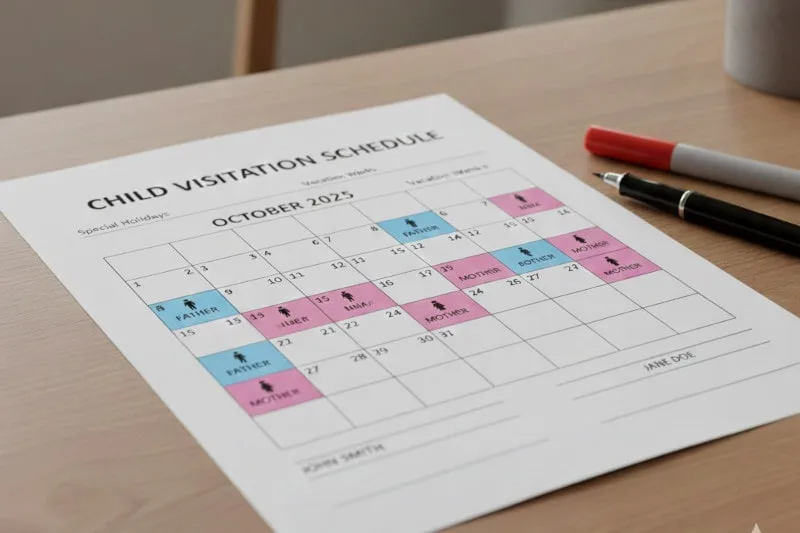
Having a custody order that outlines child visitation is essential in Nevada. But if you share custody with a co-parent who loves to argue, a vague schedule is just an invitation for more fighting. You need a parenting plan that is, frankly, court-proof.
Here at the Smith Legal Group, we’ve seen too many parents waste time and energy arguing over basic logistics. In Nevada, the court wants to see that you are prioritizing your child’s stability, and that means having a schedule that leaves nothing up to interpretation.
Why Vague Language Fails in Nevada
If your current order simply says “reasonable visitation” or “visitation on weekends,” congratulations—you have a recipe for chaos.
Nevada Revised Statute NRS 125C.010 requires that visitation rights be defined with “sufficient particularity.” That’s the legal way of saying: write down the exact times.
Vague language opens the door for your ex to claim they didn’t know when to drop the kids off, or that your definition of “reasonable” doesn’t match theirs. When you end up back in front of a judge because of these disputes, the judge will likely mandate a highly specific, written schedule anyway. Why not create it now?
Building Your Bulletproof Calendar
Creating a court-proof calendar means being painfully specific about every detail. Here are the key components to nail down for your Nevada schedule:
1. Define the Percentage Split (The Foundation)
First, decide what kind of custody you have, as this dictates the structure:
- Primary Custody (e.g., 70/30 or 80/20): This means one parent has the child for more than 60% of the time. The non-custodial parent gets defined visitation time, often every other weekend plus a mid-week dinner visit.
- Joint Physical Custody (50/50 or 60/40): This means both parents get substantial, frequent time. Nevada parents often use alternating weeks or the 3-4-4-3 schedule (three days with Parent A, four with Parent B, then four with Parent A, three with Parent B).
Be clear on which parent is considered the “custodial” parent for school registration purposes, even if the time split is close to 50/50.
2. Nail Down the Exchanges
The hand-off is where the tension usually peaks. To make this court-proof, you must specify:
Time: Is it Friday at 6:00 PM or Friday at 5:30 PM? Pick a time and stick to it.
Location: Don’t just say “at the other parent’s house.” Specify: “Exchange occurs at the front entrance of [Child’s School Name] on the last day of visitation.” If you live far apart or have high conflict, many Nevada courts prefer exchanges at a neutral, public location.
3. Holidays and Vacations (The Annual Battle Plan)
This is the section that causes the most post-judgment litigation. Do not leave holidays to chance.
- Alternate Annually: Establish a clear rotation. For example, Parent A gets Christmas Eve/Morning in even years; Parent B gets it in odd years. Do the same for Thanksgiving, Easter, and Spring Break.
- Summer Time: If you have a non-50/50 split, detail what happens during the extended summer break. Does the 30% parent get an extra two weeks? If so, specify the exact dates or reference the school calendar’s last day/first day back.
The Power of Documented Communication
When you have a difficult ex, putting your schedule in writing is only half the battle—you need to document that you followed it.
Nevada courts look favorably upon parents who use structured, recorded communication. Consider using a co-parenting app that the court recognizes (like OurFamilyWizard).
When you use these tools:
- You can log requests for schedule changes in a neutral way.
- The app provides timestamps to prove exactly when you notified your ex of your intent to follow the schedule.
If your ex refuses to comply, you have an instant, clean record for court. That’s what makes your schedule truly court-proof. If the Department of Family Services (DFS) or the court needs to step in again, you can show them clear compliance and documented attempts to maintain stability.
Finalize Your Court-Proof Visitation Schedule
A truly court-proof Nevada visitation schedule is your shield against ongoing conflict. By avoiding vague terms like “reasonable” and instead adhering to the specificity required by NRS 125C.010, you protect your child’s stability and clearly define your parental rights.
If you are dreading drafting the calendar because you anticipate your ex fighting over every detail—from pick-up times to holiday swaps—don’t try to do it alone. Our Clark County family law team specializes in translating high-conflict dynamics into crystal-clear, enforceable court orders. We use the local court’s expectations to help you build a schedule so practical and detailed that it leaves nothing for your co-parent to argue about.
Contact Smith Legal Group at 702-410-5001 for a free consultation. We will review your situation and immediately strategize how to secure a clear, enforceable schedule that keeps your child’s well-being—and your peace of mind—safe.
Disclaimer: The information in this blog post is provided for general informational purposes only, and may not reflect the current law in your jurisdiction. No information contained in this blog post should be construed as legal advice. No reader of this post should act or refrain from acting on the basis of any information included in this blog post without seeking the appropriate legal or other professional advice on the particular facts and circumstances at issue.